
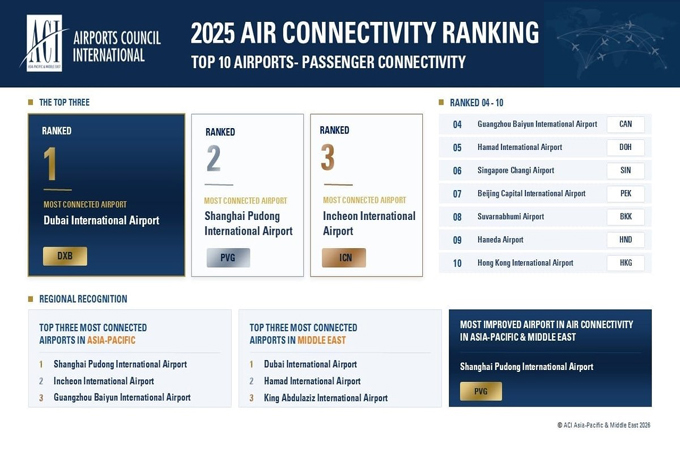
Air connectivity across Asia-Pacific and the Middle East increased by an average 11% in 2025, as airports and airlines expanded international networks and strengthened hub operations, according to the latest Air Connectivity Index from Airports Council International Asia-Pacific & Middle East (ACI APAC & MID).
The Middle East
recorded the strongest growth, with connectivity rising 21%, driven largely by
the expanding reach of Gulf-based carriers.
Asia-Pacific
connectivity grew 10%, reflecting continued network expansion and recovering
city-pair connections.
Across the 315 airports covered, 74% recorded
positive connectivity growth, although the overall increase moderated from 14%
in 2024 as the post-pandemic recovery shifted toward more sustainable
expansion.
Major hubs continued
to outperform, with 83-97% recording connectivity growth amid sustained
international travel demand and airline network expansion.
Chinese airports made
significant gains, with Shanghai Pudong International Airport, Guangzhou Baiyun
International Airport and Beijing Capital International Airport joining Hong
Kong International Airport among the region’s top 10 most connected airports.
Dubai International
Airport retained the top position in overall connectivity, followed by Shanghai
Pudong, Incheon, Guangzhou Baiyun and Hamad International Airport.
Singapore Changi,
Beijing Capital, Bangkok Suvarnabhumi, Tokyo Haneda and Hong Kong International
completed the top 10.
Shanghai Pudong posted
the strongest improvement at 32%, followed by Kuala Lumpur International
Airport at 30% and Hong Kong International Airport at 28%.
Dubai also remained
the region’s leading hub, recording a hub connectivity score nearly 40% higher
than its nearest competitor.
Shanghai Pudong,
Incheon, Hamad and Guangzhou Baiyun followed.
Connectivity growth
was also evident among emerging gateways.
Kolkata, Sharjah and
Sanya recorded the strongest improvements among airports handling 15–25 million
passengers annually, while Hanoi’s Noi Bai, Abu Dhabi International and Ho Chi
Minh City’s Tan Son Nhat led the 25–40 million passenger category.
Surabaya and Phu Quoc
stood out among smaller airports, while Da Nang, Medina and Muscat led the 5–15
million passenger group.
However, smaller
airports faced greater challenges, with only 51% of those handling fewer than
one million passengers recording connectivity growth in 2025, partly due to
airline route rationalisation and the closure of several connections.
In Asia-Pacific,
intra-regional traffic remained dominant, accounting for 91% of departing
passenger traffic, 5% higher than 2024 and 2019 levels.
Intercontinental
traffic from the region rose 7% year on year and reached 12% above pre-pandemic
levels. Middle East intercontinental traffic increased 9% and stood 27% above
2019 levels.
Stefano Baronci,
Director General of ACI Asia-Pacific & Middle East, said: “The growth in
air connectivity is encouraging. With post-pandemic recovery behind us, 2025
marked a shift from rebuilding capacity to preparing for sustained growth. With
passenger volumes across Asia-Pacific and the Middle East projected to reach 11
billion within the next three decades, it is increasingly important that we
continue to strengthen connectivity so that aviation can deliver greater choice
for passengers and wider economic benefits.”
The first half of 2026
has highlighted the sector’s resilience but also its exposure to geopolitical
and economic disruptions.
Asia-Pacific direct
connectivity grew 0.5% year on year, while passenger traffic increased about
1.6%.
In contrast, Middle
East connectivity fell 23% as regional conflict forced airlines to reduce
schedules and reroute around affected airspace.
Baronci said: “Despite
the macroeconomic challenges, the Asia-Pacific region proved resilient in the
first half of 2026, with passenger traffic increasing by approximately 1.6%
year on year, though the outlook remains challenging. Boosted by growing international
demand and a strong domestic traffic base, we still forecast growth in the
medium and long term. As the operating environment evolves, the focus is
increasingly on how these efforts can support greater resilience and
sustainable growth. This includes making better use of existing capacity,
strengthening operational reliability, improving the passenger experience, and
investing in new infrastructure and technology.”
“ACI Asia-Pacific & Middle East recommends strengthening the policy and regulatory environment that enables connectivity growth, including the revision of existing air service agreements, continued easing of visa requirements, and reforms to enhance the slot allocation framework,” Baronci added.-TradeArabia News Service