
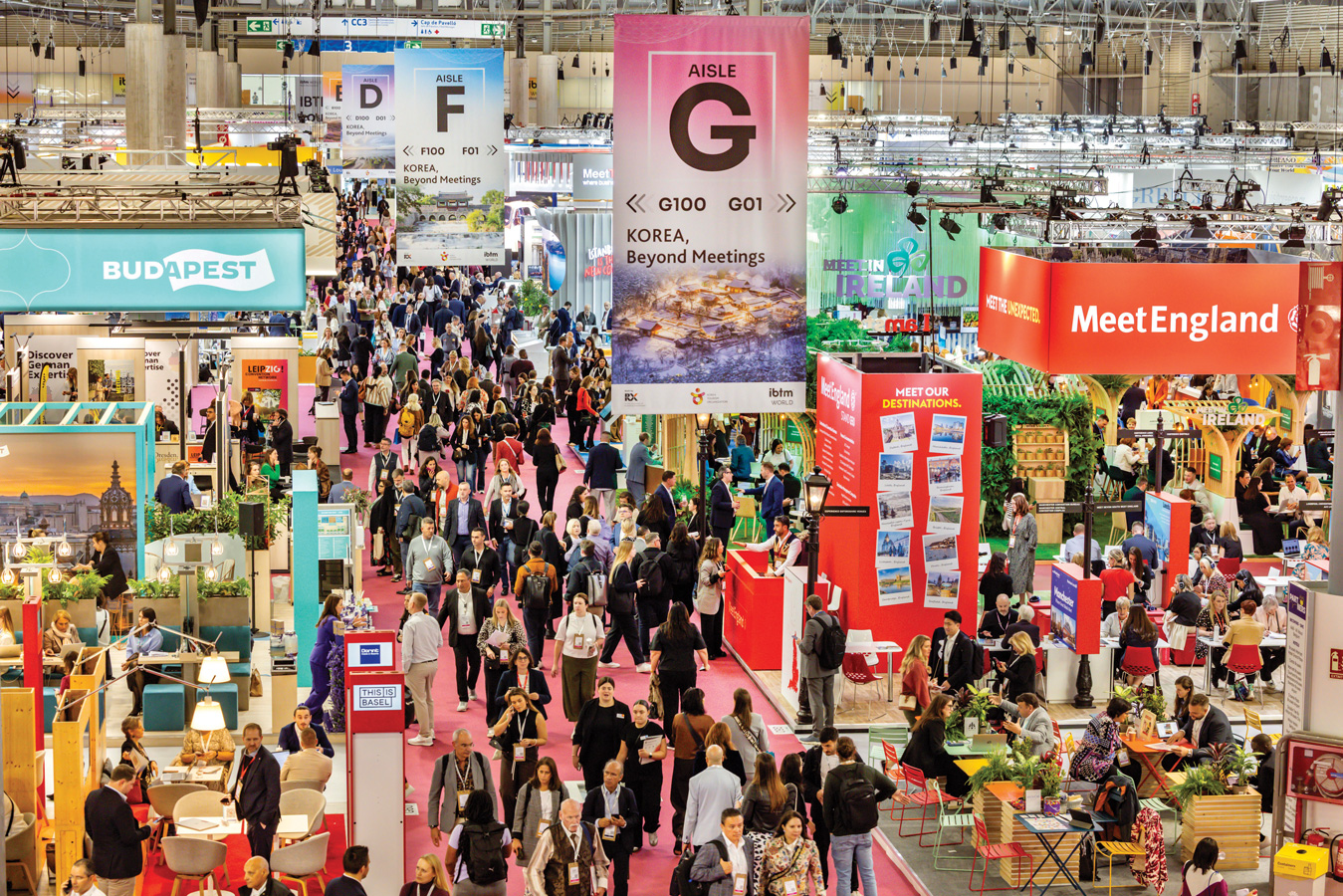
In an increasingly fragmented world, business events are becoming vital infrastructure for connection, knowledge exchange and long-term growth. According to the American Express Global Meetings and Events Forecast 2026, 85% of meeting professionals are optimistic about the year ahead - the highest level recorded in five years, and 77% of event professionals expect attendance to match or exceed pre-pandemic levels in 2026. At the same time, 71% expect the cost per attendee to rise, highlighting the tension between growing demand for in-person connection and the economic pressures making international gatherings more challenging to deliver.
The business events industry remains strong and resilient however, not only because of the direct benefits it brings, but because it has a meaningful role to play in how business and communities stay connected as the world grows more complex. Although the world feels particularly volatile and fractured right now, more than ever, now is the time to champion the role that our industry can play in fostering links, sharing knowledge and supporting cooperation between borders.
Helping economies
grow, adapt and thrive
As the industry we all know and love, we understand that business events can bring hugely positive socio-economic benefits to a destination. What’s not talked about as often, however, is the way that business events can go beyond the surface-level benefits of hotel nights, hospitality, local transport and retail to create the infrastructure through which economies grow, adapt and thrive.
Some emerging destinations, such as Rwanda for example, have deliberately built up a business events economy as part of a wider strategy for economic development and international positioning. Kigali is an interesting example: investment in the Kigali Convention Centre, connectivity, hospitality and the wider business events ecosystem has helped establish the city as a regional hub for international conferences and business events. In 2025, Rwanda’s business events sector generated US$94.7 million, up 11% on the previous year.
The significance of this reaches far beyond the direct economic contribution. Business events have helped Rwanda build the infrastructure, relationships and international profile to support a much broader economic ecosystem.
Other destinations have used business events as a tool to help them diversify economically. Dubai, for example, has invested heavily in establishing itself as a global business events hub, recognising that the value of international meetings doesn’t stop with visitor expenditure – it also supports knowledge development, innovation and the creation of new business relationships. In this way the event itself is not the end goal, it’s the catalyst.
And because business events – particularly association events – move between countries, and incentives pride themselves on showing delegates different destinations and experiences, they can also help put lesser-known destinations on the map. This can diversify visitor economies beyond the traditional leisure tourism model, creating demand for air routes, accommodation, hospitality and experiences in places that might otherwise struggle to attract an international audience.
From creating the infrastructure to support a business events industry – such as airports, hotels and transport routes – from scratch, to improving existing facilities and services, business events can underpin and strengthen economies in multiple ways. But the most interesting impact is often what remains after the delegates have gone home: better connectivity, new skills, stronger international networks and a destination that has demonstrated its ability to host the world.
Leading with
business events
Our industry is one built from resilience, cross-nation partnerships, and openness, and we can be proud that one of its key strengths is bringing people together. Although traditional measures of success for our industry still matter, rather than measuring room nights, delegate spend or even economic value alone, our key measurements going forward in this volatile world should perhaps be: how many relationships have we created? How much knowledge have we shared? How many partnerships have been formed? How much investment or innovation has been unlocked? Because in a more fragmented world, connection itself becomes an asset.
The legacy begins
after delegates leave
One of the key roles of business events is knowledge sharing. Business events excel in enabling the stress-testing ideas against a live, in-person audience, and spreading new ideas quickly and across different countries. A medical conference, for example, should therefore be judged by more than simply how many hotel nights, restaurant bookings or transport journeys it generated for the local economy. What if the more important question is what happens because those researchers, clinicians, policymakers and businesses were in the same room?
Equally, that same conference may have attracted investment for a new product, fostered links between research institutions, accelerated knowledge and research, created opportunities for early-career scientists, or enabled a breakthrough in one country to be shared rapidly with another. These outcomes are harder to measure than delegate spend, but potentially far more significant.
Championing the role
of soft power
A strong business events economy can play an equally important role in nation branding. Harder to measure but crucially important, soft power can influence everything from trade and investment to diplomatic standing on the world stage.
Attracting a technology event to a city, for example, can help position it as a technology hub, connect companies with talent, expose policymakers to emerging issues and attract future investment. Abu Dhabi has gone as far as explicitly linking its business events strategy to its wider Economic Vision 2030, assessing prospective events not simply on visitor numbers but on their economic, social and cultural impact.
The best destinations aren't asking: “How many people will this event bring?” They're asking: “What does this event help us become?”
Measuring what
happens next
This doesn't mean that every event automatically creates meaningful legacy, or that growth should be pursued at any cost. The industry must also confront the environmental cost of international travel, the barriers created by visas and affordability, and the question of whether an event is genuinely delivering something that cannot be achieved elsewhere.
If we are going to position business events as part of the infrastructure of future economies, we have to continue to be intentional about the outcomes we are trying to create.
The forces making international collaboration harder – geopolitical tension, economic uncertainty, climate pressures and technological disruption – are likely to persist, but perhaps that makes the role of business events clearer, rather than less relevant.
Our industry has traditionally measured its success in the people we attract, the nights they stay and the money they spend. Those measures still matter, but they don't tell the whole story. The opportunity is to measure what happens next: the relationships formed, the collaboration that begins, the investment that follows, the talent that is attracted, the idea that travels across borders.
This is the real value in business events, and in an increasingly fragmented world, that may be one of the most important economic contributions our industry can make.
* Claudia is IBTM World’s Exhibition Director