
China’s travel market is becoming more diverse, with travelers placing greater emphasis on quality, authentic experiences and personalised services, while artificial intelligence (AI) is increasingly influencing the entire travel journey, according to the ITB China Travel Trends Report 2026/27.
The findings are based on research involving 1,700
ITB China Buyer Circle representatives, alongside market
data and industry insights from Tourism Economics, Fliggy and
Ant International.
China’s outbound market recorded strong growth in
2025, with mainland Chinese residents making 167.92 million
outbound trips, up 16% year on year. Asia-Pacific remained
the leading destination region, while Europe, the Americas and
the Middle East continued to show potential. Visa policies, air
connectivity and bilateral relations are increasingly
shaping destination choices, with markets such
as Georgia and Egypt benefiting from improved access.
Inbound travel to China also accelerated. The country
welcomed 35.17 million foreign visitors in 2025, a 31%
increase from the previous year. Visa facilitation,
combined with China’s cultural heritage, cuisine and natural
attractions, supported the growth, with strong demand from
both Asian and long-haul markets.
The report found that price remains important, but
travelers are increasingly assessing value through a combination
of cost and quality. Authenticity, flexibility and personalisation are
becoming stronger influences on purchasing decisions.
This shift is particularly visible across luxury,
cruise, cultural and study, and outdoor and sports travel. Luxury
travelers are increasingly seeking cultural immersion, exclusive
access and tailored services, while cruise operators face growing
demand for personalised experiences and digital services. Cultural
travel is moving toward immersive learning, while outdoor and
sports products are placing greater emphasis on specialist
expertise, community engagement and sustainability.
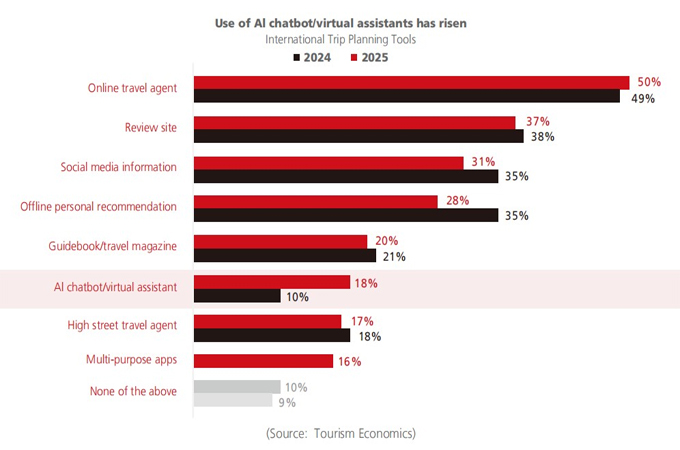
AI is emerging as another major force.
Tourism Economics’ 2025 Travel Trends Survey found that the
share of global travelers using AI chatbots or virtual
assistants had nearly doubled year on year, with almost one in
five using them to plan international trips. Travel
companies are also applying AI to customer service, operations
and content creation.
The report, however, highlights the continued
importance of human interaction as travelers seek trust, personalisation
and high-quality service.
China’s MICE market is also adapting, with technology, new energy, robotics and advanced manufacturing emerging as important client sectors. Companies are increasingly focusing on fewer, higher-impact events, while smaller businesses favor more targeted gatherings amid budget pressures. -TradeArabia News Service