
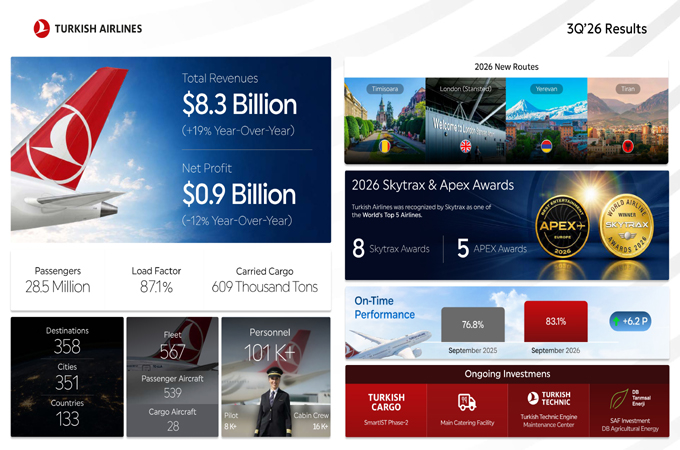
Turkish Airlines reported an operating profit of $929 million in the third quarter of 2026, with total revenues increasing 19.3% year on year to $8.3 billion, supported by strong passenger and cargo demand despite rising fuel costs and geopolitical uncertainty.
The airline carried
28.5 million passengers between July and September, up 4.7% compared with the
same period last year, while its passenger load factor increased by 1.5
percentage points to 87.1%.
Demand was
particularly strong across Asia, Europe and Türkiye, enabling the carrier to
maintain its position as Europe's leading network airline by number of flights.
However, the airline
faced mounting cost pressures, with jet fuel prices increasing 118% since the
beginning of the year, alongside inflationary pressures affecting non-fuel
expenses.
Reflecting the impact
of the Middle East conflict on demand and operating conditions, Turkish
Airlines revised its 2026 passenger capacity growth target of 10% downwards.
Capacity increased by 3.2% in the third quarter.
Cargo operations
provided additional support to financial performance. Turkish Cargo increased
freight volumes by 7.4%, while cargo revenues surged 45.6% to more than $1.2
billion in the third quarter.
Despite revenue
growth, higher operating expenses, particularly fuel costs, weighed on
profitability. Earnings before interest, taxes, depreciation, amortisation and
rent (EBITDAR) reached $3.7 billion in the first nine months of 2026, while the
EBITDAR margin declined by 6.2 percentage points year on year to 17.6%.
The airline said it
had focused on operational efficiency, flexible capacity management and
directing flights towards markets with stronger demand to mitigate the impact
of rising costs and market uncertainty.
Turkish Airlines'
total investments reached $4.6 billion during the first nine months of the
year, while consolidated total assets exceeded $52 billion.
The carrier said its
extensive international network, strategic location and flexible business model
continued to support its operations amid challenging global aviation market
conditions.
Turkish Airlines Chairman of the Board and
the Executive Committee Murat Şeker, stated: “The conflict in the Middle East
and persistently high jet fuel prices placed significant pressure on the global
aviation industry in the third quarter. Against this backdrop, we maintained
our focus on operational efficiency and cost discipline while adapting to
changing demand conditions by leveraging the opportunities offered by our
extensive flight network. Despite increasingly challenging operating
environment, growing our passenger numbers and load factors in each month of
the third quarter clearly demonstrate the strength of our flexible business
model and operational capabilities. Given the current circumstances, we are
taking a selective approach to capital allocation, directing our resources
towards strategic investments with high value creation potential. Supported by
our strong balance sheet, we continue to invest in our brand and customer
experience. The awards presented to us by APEX and Skytrax further underscore the
international recognition of these efforts. In line with our commitment to
operational excellence and stronger global connectivity, we will continue to
bring people and cultures together while making sustainable contributions to
the aviation industry.” -TradeArabia News Service