
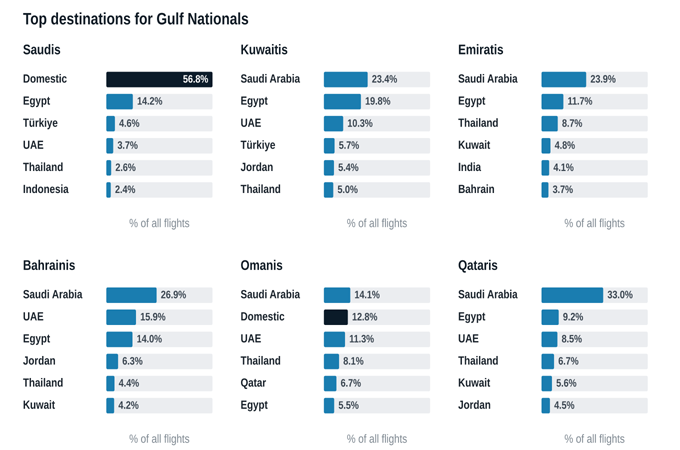
Travel demand across the Middle East remained resilient during the first eight months of 2026 despite significant airspace and flight disruptions, with travellers continuing to search for trips even as completed bookings fell, according to new data from Wego.
The region’s travel
landscape also saw notable shifts in destination performance, with Egypt
retaining its position as the most searched destination for a 12th consecutive
year, while Nepal, China, Vietnam, Sudan and Kenya recorded some of the biggest
gains. Pakistan has also climbed sharply over the past decade, rising from 21st
to fourth place.
Wego’s annual Middle
East Traveller Destination Leaderboards, based on search and booking data from
January 1 to August 31, 2026, compared with the same period last year, found
that access and connectivity were among the strongest factors influencing destination
performance. The report also highlights a growing difference between the travel
behaviour of Gulf nationals and the wider Gulf market.
Within a week of
airspace restrictions and flight disruptions beginning in late February, flight
bookings from the Gulf dropped to 63% of the previous year’s level, despite
relatively resilient search activity. Bookings recovered to 2025 levels in
early May before another period of disruption in June, while peak-summer travel
patterns began to normalise from July.
The divergence
suggests that travellers continued planning and researching holidays even when
their ability to travel was constrained.
Ross Veitch, CEO and
co-founder of Wego, said: “Travel demand in the Middle East proved far more
resilient this year than the headlines suggested. When airspace closed, people
did not stop planning trips, searches held steady even as bookings halved. What
travellers lost was the ability to fly, not the intention to. Access, not
appetite, sets the ceiling on destination performance in this region.
“The second shift
matters just as much. The Gulf market and Gulf nationals are two different
audiences with two different maps, and a single corridor between Saudi Arabia
and Egypt now carries almost a fifth of all travel abroad by Gulf nationals.
The destinations that plan around that distinction will win share from those
still treating the region as one audience.”
Egypt maintains
dominance as emerging destinations gain
Egypt remained at the
top of Wego’s destination rankings for the 12th consecutive year, followed by
India and Saudi Arabia.
Further down the
leaderboard, however, the rankings showed considerable movement. Nepal climbed
eight places, the largest increase recorded, while China, Vietnam, Sudan and
Kenya each advanced seven positions.
Pakistan’s longer-term
rise is even more pronounced. It has moved from 21st place a decade ago to
fourth in the latest rankings, underlining the changing nature of regional
travel demand.
Improved access was a
major factor behind several of the strongest-performing destinations. China
benefited from expanded visa-free access for GCC nationals, while Vietnam
gained from increased direct connectivity between the Gulf and Hanoi.
The findings indicate
that destinations investing in easier access are increasingly well positioned
to turn traveller interest into actual demand.
European destinations
face uneven demand
Travel disruption
affected destinations and regions differently. Search demand for Azerbaijan
fell 39% year on year, while Georgia recorded a 29% decline. Spain, despite its
greater geographic distance from the Gulf, saw search demand fall by only 3%,
suggesting that distance alone does not determine destination performance.
Europe as a whole
recorded a 20% decline in search demand. By contrast, the Indian Subcontinent
was the fastest-growing region in Wego’s analysis, rising 19%, led by Pakistan,
which grew 34%.
Within MENA, Saudi
Arabia proved comparatively resilient, with search demand declining 15.8%.
Egypt continued to lead the region as the most searched international
destination.
Gulf nationals show a
different travel map
For the first time,
Wego separated the travel behaviour of GCC nationals from that of the wider
Gulf market, revealing significant differences between the two audiences.
The Saudi Arabia-Egypt
corridor alone represented 19.6% of international travel by Gulf nationals in
Wego’s dataset, highlighting the importance of the route.
Saudi travellers also
showed a strong domestic travel pattern, with 56.8% of flights being domestic.
Among their international journeys, 84% extended beyond the GCC, pointing to a
broad international travel footprint.
Airfares and hotel
demand reflect changing behaviour
Airfares rose from
March and reached a peak in June, when average prices were 23% above the
previous year. By August, however, fares had returned to within approximately
1% of 2025 levels.
Hotel demand followed
a different pattern. Domestic hotel bookings increased 37% year on year, while
international hotel bookings declined 9%. Overall hotel bookings still rose
17%, indicating stronger demand for domestic stays as international travel faced
disruption.
Travellers also
adjusted the structure of their journeys. One-way international flight searches
increased from 57% before the disruption to 76% in March before moving closer
to previous levels by August.
Looking ahead, Wego
expects connectivity, accessibility and travel costs to remain key factors
shaping destination performance through the rest of 2026 and into 2027.
Destinations that have strengthened their position through new air routes or
expanded visa access may be better placed to retain gains as travel patterns
normalise.
The growing distinction between Gulf nationals and the wider resident population could also encourage more targeted strategies from destinations, airlines and tourism businesses seeking to capture Middle East travel demand. -TradeArabia News Service