
A new global study by PlayersTime has ranked the world’s most Instagrammable travel destinations for 2026, highlighting the growing influence of social media on tourism trends and traveller choices.
The rankings were based on an “Instagrammability Score” combining global Google search demand with hashtag activity across Instagram and TikTok.
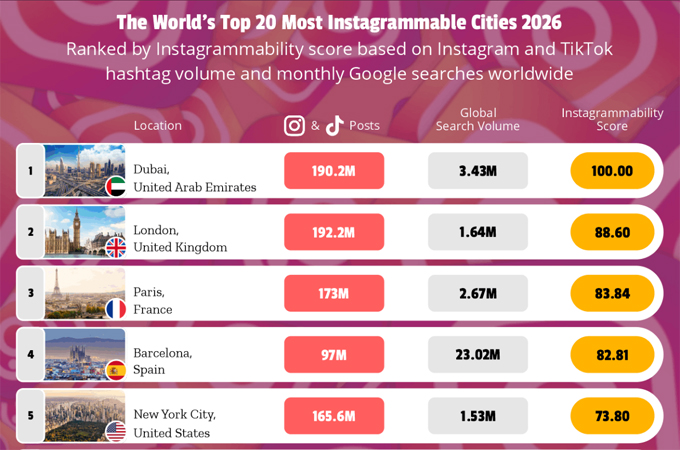
Dubai topped the global city rankings with a perfect score of 100, supported by more than 190 million social media posts and 3.4 million monthly searches.
Barcelona followed as the world’s most searched destination, generating 23 million monthly Google searches and 97 million tagged posts, while London, Paris and New York also ranked among the leading cities.
Among landmarks, the Burj Khalifa in Dubai was named the world’s most Instagrammable site, recording more than 10 million tagged posts and 1.1 million monthly searches.
The Eiffel Tower ranked second, followed by landmarks including the Taj Mahal, Machu Picchu and Barcelona’s Sagrada Família.
The report found that urban destinations continue to dominate global travel content, with visually recognisable locations and social-media-friendly experiences driving engagement.
Places such as Tokyo’s Shibuya Crossing and New York’s Times Square ranked highly despite being known more for atmosphere and activity than traditional sightseeing.
The study also highlighted a growing interest in lesser-known destinations.
Spain’s Setenil de las Bodegas topped the ranking of unusual Instagrammable locations, ahead of Japan’s Hitachi Seaside Park, Australia’s Wave Rock and Colombia’s Cano Cristales.
Regionally, Europe recorded the highest concentration of top-ranked landmarks, while Asia and the Middle East were led by Dubai and Turkey’s Cappadocia.
In the Americas, the Grand Canyon South Rim and Machu Picchu ranked among the strongest-performing destinations.
According to the report, social media visibility is increasingly shaping travel demand, with destinations gaining popularity through viral imagery and online engagement rather than traditional tourism marketing alone. -TradeArabia News Service